n8n Cloud vs Self-Hosted: What the Pricing Page Says
n8n bills Cloud per workflow execution and gives the self-hosted build away under a fair-code license. Here are the quotas, retention windows, excluded features and license lines, quoted from n8n's pricing page and docs as of October 2026.
This article is a documentation review: it is based on the vendors' own published pages, checked on the date shown. We may earn a commission from some links; it never affects what we recommend.
n8n sells the same product two ways: a managed Cloud subscription billed per workflow execution, and a self-hosted build you run under the Sustainable Use License. The short answer is that Cloud buys a fixed quota, fixed retention and no servers, while self-hosting buys unlimited executions and retention you configure yourself, minus roughly ten team features that sit behind a paid key. This note reads n8n's pricing page, hosting docs, environment-variable reference and license FAQ as of October 2026 and quotes the limits as published. Where a page does not state a figure, the note says so instead of guessing.
Count executions, not steps, before you compare plans
n8n's billing unit is the workflow execution. The pricing page, checked October 9, 2026, states that "An execution is a single run of your entire workflow." A run that touches two nodes and a run that touches two hundred both count once.
That rule separates n8n from per-task and per-step tools. A quota of 2,500 executions is 2,500 runs, however long each one is. Every plan also includes unlimited users, unlimited workflows and every integration, so none of those moves the price.
Two limits do move with the plan: concurrent executions and execution data retention. Both are covered below, because they decide whether a cheap plan actually fits a busy workflow.
Read the Cloud plan limits line by line
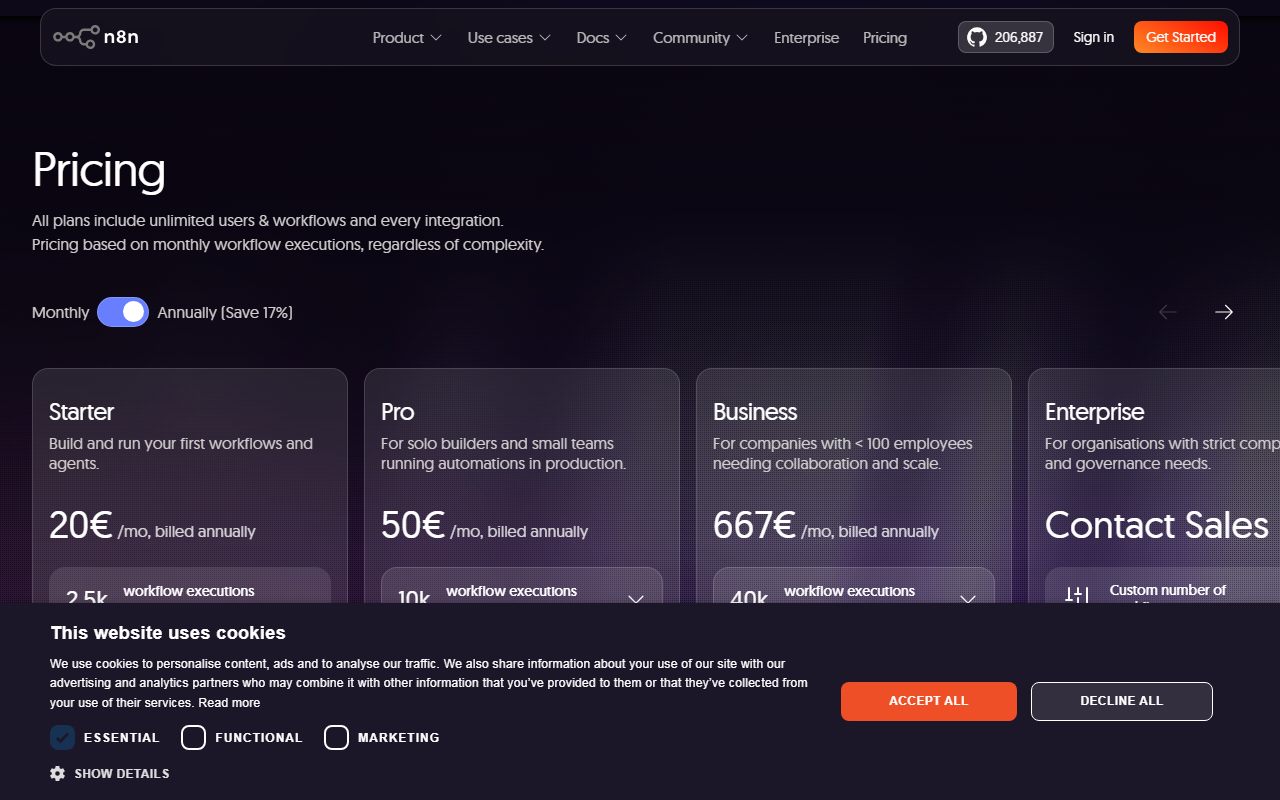
Four Cloud plans are listed, with prices shown in euros and billed annually. The page displayed no monthly-billed prices when read from our location. Its contract forms offer separate dollar and euro payment, so a dollar list price is not quoted here.
- Starter - 20 euros per month billed annually, 2,500 executions per month, 5 concurrent executions, 1 shared project, 2,500 saved executions, 7 days of execution log retention, 2.5 GB of storage and a 5-minute maximum execution duration.
- Pro - 50 euros per month billed annually, 10,000 executions per month, concurrency listed as 20 or 50 depending on the Pro tier, 3 shared projects, 25,000 saved executions, 30 days of retention, 25 GB of storage and a 40-minute maximum duration.
- Business - 667 euros per month billed annually, 40,000 executions per month, 6 projects, SSO and LDAP, multiple environments, Git version control and queue mode. The page marks it "Self-hosted only" with a Cloud waitlist.
- Enterprise - custom pricing, 200 or more concurrent executions, unlimited projects, 50,000 saved executions, unlimited log retention, 50 GB of storage, log streaming, external secrets and dedicated support with an SLA.
- Free trial - 1,000 executions, 5 concurrent executions, a 180-second timeout and one team project, with no credit card required.
Retention has two counters: a saved-execution cap and a day limit. The Cloud data management page states that the oldest executions are removed first when either limit is hit, and that reaching a limit does not stop workflows from running.
Overage is only described for Business and Enterprise. The FAQ states those workflows keep running past quota, with overage billed at 4,000 euros per extra bucket of 300,000 executions. The page does not state what happens when Starter or Pro exceeds its quota.
Check what the Community edition leaves out
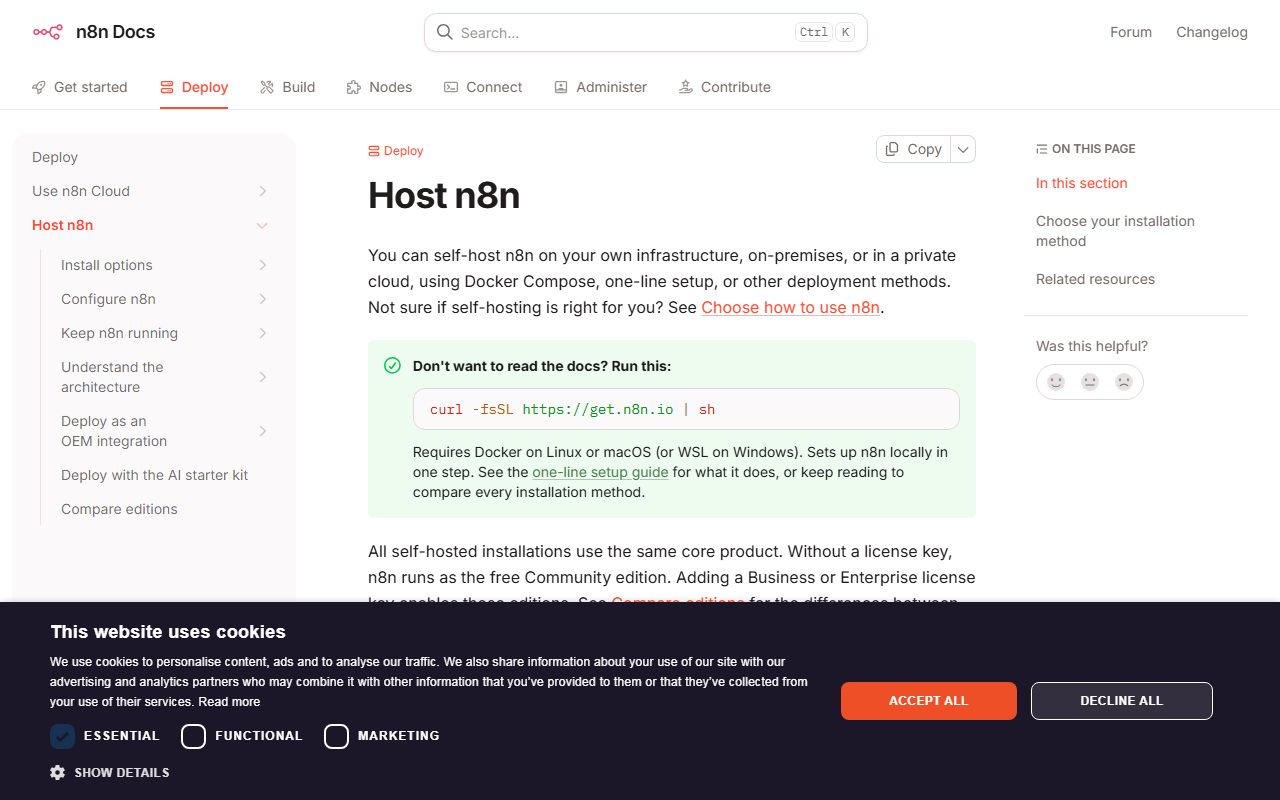
The free self-hosted build is what n8n runs without a license key. The hosting docs describe it as "almost the complete feature set of n8n," and the Community edition feature page confirms that logging and queue mode are included.
Ten features are excluded and require a Business or Enterprise key: custom variables, environments, external secrets, external storage for binary data, log streaming, multi-main mode, projects, SSO with SAML or LDAP, sharing of workflows and credentials, and version control using Git.
Registering the Community edition with an email address returns a free license key that adds three more features: folders, debug in editor, and custom execution data. That step costs nothing and does not change the license you run under.
Paid self-hosted keys phone home. The pricing FAQ states a Business or Enterprise key "must ping our license server daily to stay active," and that the ping includes the number of production executions. Air-gapped installs can use a certificate via N8N_LICENSE_CERT instead.
Installation has changed. The hosting page recommends the one-line setup, which needs Docker on Linux, macOS or WSL, or Docker Compose for production. It states that "npm installation is deprecated from n8n 3.0."
Set your own retention and concurrency when you self-host
Self-hosting removes the execution quota entirely. The environment-variable reference lists N8N_CONCURRENCY_PRODUCTION_LIMIT with a default of -1, meaning no production concurrency cap, and EXECUTIONS_TIMEOUT at -1, meaning no execution time limit unless you set one.
Retention is on by default but shorter than many teams assume. EXECUTIONS_DATA_PRUNE defaults to true, EXECUTIONS_DATA_MAX_AGE to 336 hours, which is 14 days, and EXECUTIONS_DATA_PRUNE_MAX_COUNT to 10,000 executions. Pruning fires when either condition is met.
You decide what is saved. EXECUTIONS_DATA_SAVE_ON_SUCCESS and EXECUTIONS_DATA_SAVE_ON_ERROR both default to all, manual executions are saved by default, and node progress is not. Each setting can also be overridden per workflow.
Two gotchas sit in the docs. Executions that are running, waiting, or annotated with tags or ratings are never pruned. And on SQLite, pruned space is not returned to disk until you set DB_SQLITE_VACUUM_ON_STARTUP or run VACUUM yourself.
The trade is plain: Cloud Starter gives 7 days and 2,500 saved runs with no admin work. A self-hosted default gives 14 days and 10,000 runs, and any number you choose above that, in exchange for owning the database.
Read the Sustainable Use License before you resell anything
Self-hosted n8n is not OSI open source. The license page describes the Sustainable Use License as "a fair-code software license created by n8n in 2022." Files with .ee. in the name fall under a separate Enterprise License and need a paid key.
The core grant is narrow: you may use or modify the software "only for your own internal business purposes or for non-commercial or personal use." Redistribution is allowed only free of charge and for non-commercial purposes, with n8n's notices left intact.
The license FAQ draws the line for agencies. Building and running client workflows on your own instance, and charging for setup, maintenance or consulting, is allowed as long as "clients receive outputs, not access." Installing n8n on a client's own server is also allowed.
What is not allowed: hosting n8n as a service where clients build workflows, white-labeling by removing n8n branding, forking the code to launch a rival automation product, or embedding a workflow builder that end users configure, even through a custom UI, API or AI agent.
The FAQ's test is one question: "is n8n the thing being sold, or is it a tool that supports something else being sold?" Products that use n8n as an invisible backend pass; an embedded builder needs an Enterprise license from sales@n8n.io.
Match the plan to the workload you can describe in numbers
Write down three figures before choosing: production runs per month, peak simultaneous runs, and how many days of execution data support needs. Cloud Starter fits under 2,500 runs, 5 at once and 7 days. Pro covers 10,000 runs and 30 days.
Self-host when run counts are high, the data must stay in your own database, or jobs run past the 40-minute Cloud ceiling. Budget engineering time for Docker, backups and upgrades; the docs state self-hosters provide and maintain their own infrastructure.
Pay for a self-hosted Business key only when SSO, environments, projects or Git version control are required on your own servers. At 667 euros per month billed annually, weigh it against Cloud Pro plus the staff time self-hosting consumes.
Frequently asked questions
Is self-hosted n8n free for commercial use?
Yes, for internal business purposes. The Sustainable Use License lets a company run n8n for its own workflows at no cost. It does not allow hosting n8n for customers, white-labeling it, or embedding a builder that outside users configure, as of October 2026.
How many executions does n8n Cloud Starter include?
2,500 workflow executions per month, with 5 concurrent executions, 7 days of execution log retention and a 5-minute maximum execution duration, per the pricing page checked October 9, 2026. The page showed the price in euros: 20 per month billed annually.
How long does self-hosted n8n keep execution data?
14 days or 10,000 executions by default, whichever is reached first, per the EXECUTIONS_DATA_MAX_AGE and EXECUTIONS_DATA_PRUNE_MAX_COUNT defaults in the environment-variable reference. Both can be raised, and setting the count to 0 removes that cap.
Bottom line
Choose n8n Cloud when monthly runs fit the 2,500 or 10,000 quotas and nobody on the team wants to run Docker. Choose self-hosting when run counts, retention or data residency matter more than convenience, and treat the 14-day default pruning as a starting point.
Read the license FAQ before putting n8n in front of clients: outputs are fine, access is not. Re-check the pricing page before buying, since every figure above is as of October 2026 and n8n changes plans without notice.
Sources
- n8n pricing page (checked Oct 9, 2026)
- n8n docs - Self-hosting n8n (checked Oct 9, 2026)
- n8n docs - Community edition features (checked Oct 9, 2026)
- n8n docs - Cloud data management (checked Oct 9, 2026)
- n8n docs - Executions environment variables (checked Oct 9, 2026)
- n8n docs - Sustainable Use License (checked Oct 9, 2026)
- n8n docs - License FAQ (checked Oct 9, 2026)
- n8n GitHub - LICENSE.md (checked Oct 9, 2026)