What Influencer Marketing Platforms Cost
Three influencer platforms publish prices, and no two meter the same unit. This guide lines up profile opens, credits and collaboration volume, and checks the annual discount arithmetic.
This article is a documentation review: it is based on the vendors' own published pages, checked on the date shown. We may earn a commission from some links; it never affects what we recommend.

Influencer platforms are among the least transparent tools in a social stack. Most send you to a demo form. Three of them publish numbers, and those three meter three completely different units.
This guide reads the published pricing pages of Modash, Favikon and Storyclash. Every figure below was read in the page markup on October 31, 2026.
Three more vendors were attempted and are absent for a reason worth stating. The Heepsy, Collabstr and Upfluence pricing pages returned a bot-verification interstitial rather than a price list, so no figures from them appear here.
Modash meters opened profiles
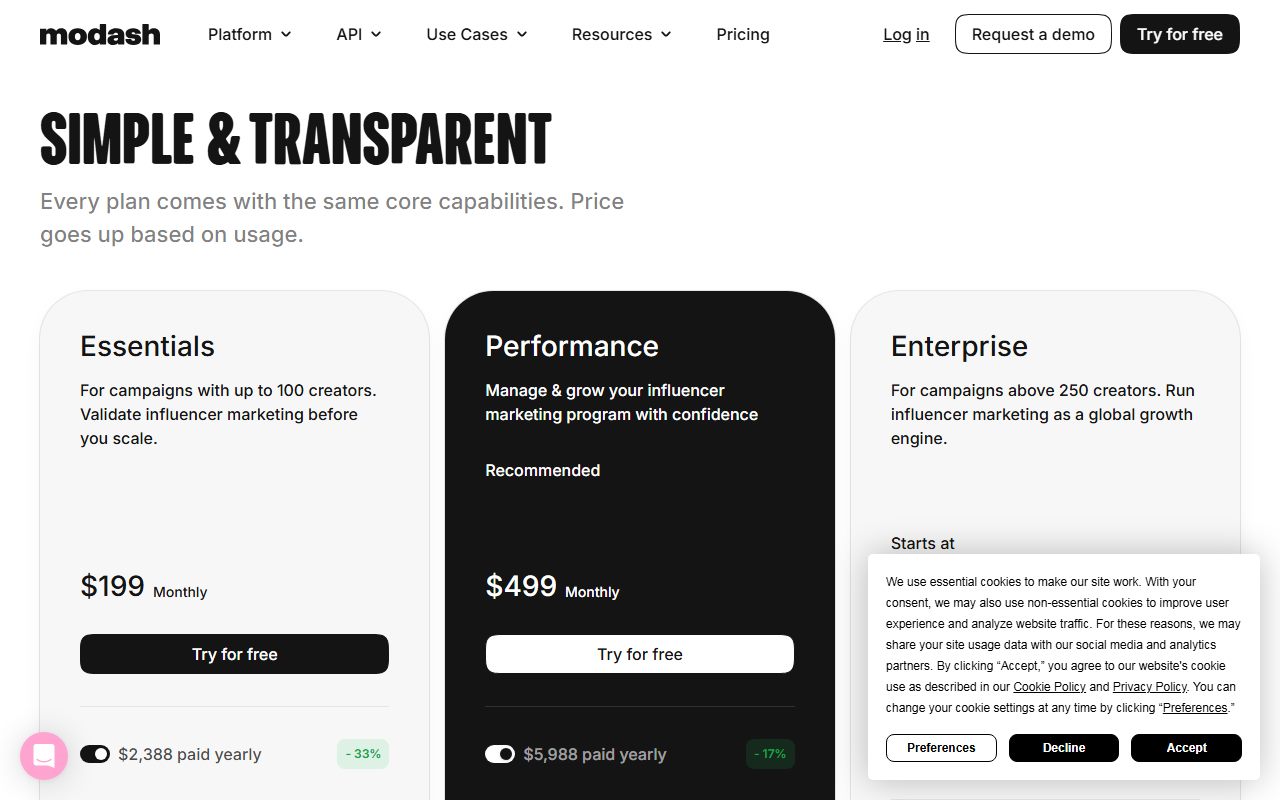
Modash sells by how many creator profiles you look at. Essentials is listed at $199 a month, with 2 team members, 300 opened profiles, 150 unlocked creator emails and 100 tracked creators' content.
The page notes that the profile limit "resets monthly". Performance is listed at $499 a month, with 5 team members, 800 opened profiles, 400 unlocked emails and 250 tracked creators.
Enterprise is described for "campaigns above 250 creators" and listed as "Starts at $14,700" yearly. The page describes Discover as "a deep search engine with 380M+ profiles", which is a vendor claim rather than an audited figure.
Payouts are priced separately and the detail matters. Performance lists "Payments (0% fee up to $10K/yr)", and the footnote states the $10,000 ceiling covers Payments and Affiliates combined, after which "5% fee applies".
On Enterprise the same mechanism scales. The page lists 0% fee on payouts up to $100,000 a year, then says the fee-free band continues "within specific payout tiers" with 5% on anything above a tier limit.
The annual discount arithmetic does not close
Modash's Essentials card shows three things at once: $199 monthly, "$2,388 paid yearly" and a badge reading minus 33 percent. Twelve times $199 is exactly $2,388 by editorial calculation.
So the monthly figure and the yearly figure describe the same rate. The 33 percent is measured against a monthly list price that does not appear anywhere on the page read here.
Performance repeats the pattern. It shows $499 a month, "$5,988 paid yearly" and minus 17 percent, and twelve times $499 is exactly $5,988 by editorial calculation.
This is not a trivial point. Two discount badges on one page, 33 percent and 17 percent, are both measured against figures the buyer cannot see, which is precisely the problem described in how to read a social media tool pricing page.
Favikon meters credits, then sells more of them
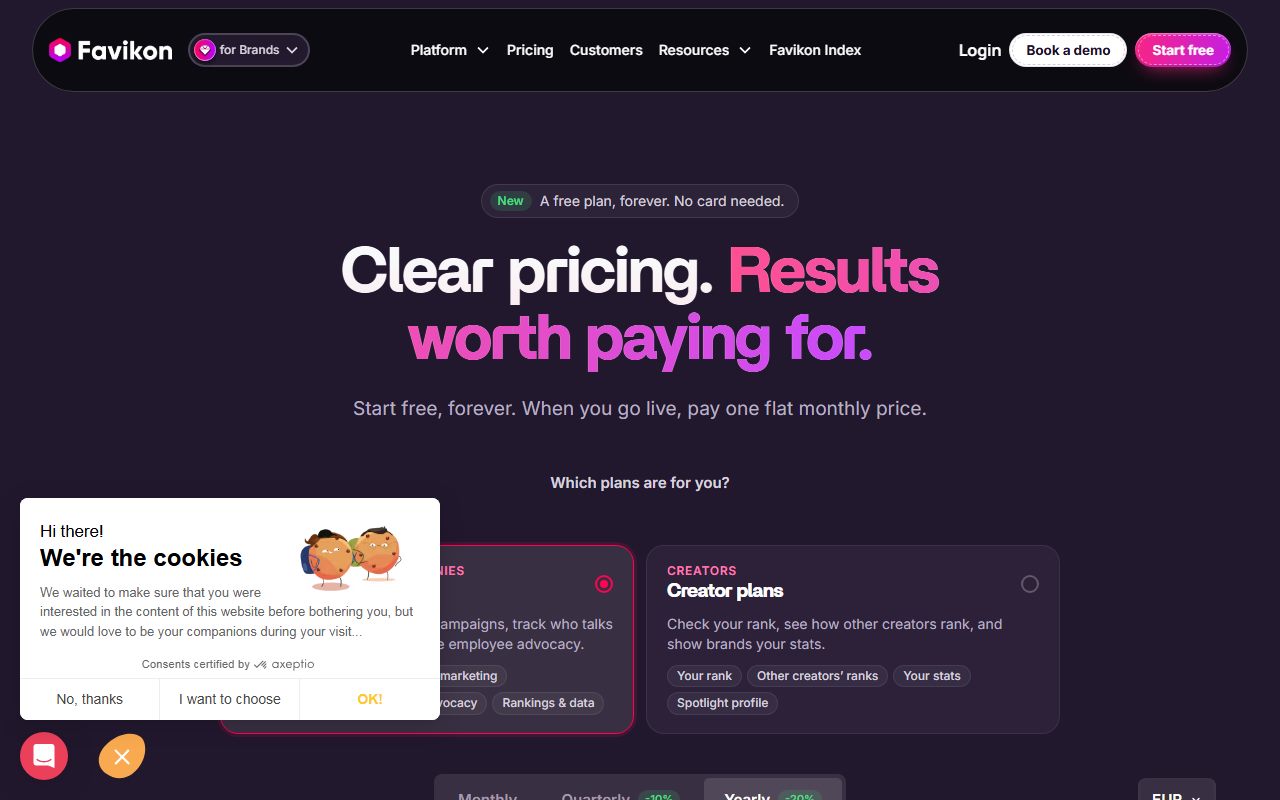
Favikon runs on credits. Its free tier is listed at €0 with "15 credits / month, refilled". Core includes 500 credits a month and Pro includes 1,000 credits a month.
The page explains what a credit buys: "Search: 1 per creator in results (tighter filters cost less). Lookalikes and Radar: 2 per creator." So a loose search is more expensive than a precise one.
Credits can be raised inside a tier. On Core, 500 credits is listed at €159 a month, 1,000 at €302, 2,000 at €573 and 3,000 at €812, each step carrying a small advertised saving.
Pro runs the same ladder from a higher base: 1,000 credits at €239 a month, 2,000 at €454, 3,000 at €646 and 5,000 at €1,017. Enterprise is listed as "From €499" a month.
Separate credit packs sit outside the plans, at 500 for €50, 1,100 for €100, 3,000 for €250, 6,500 for €500 and 14,000 for €1,000. The page says packs "carry over across months" while plan credits are used first.
Credit systems are the same mechanism publishing tools use for generated copy and images, with the same budgeting hazard. The parallel is drawn out in what AI credits in social media tools actually buy.
Favikon also charges for seats
One full seat is included. Beyond that the page lists a Full seat at €69 a month, described as "Creates and edits everything", and an Analyst seat at €39 a month, described as "Views and comments, read-only".
There is a sensible carve-out. The page states that showing one campaign to a boss or client can be shared "for free, no seat needed", which is rarer than it should be.
A read-only tier at nearly sixty percent of the price of a full seat is still a real cost at agency headcount. The definitions vary sharply by vendor, as set out in what counts as a seat in social media tools.
Favikon's headline prices come with a caveat. Core renders both €159 and €199, and Pro renders both €239 and €299, against a toggle offering Quarterly at minus 10 percent and Yearly at minus 20 percent.
The gap in each pair is almost exactly the advertised 20 percent by editorial calculation. The page nonetheless prints the label "per month, billed annually" beside the higher figure, which reads backwards, so this guide does not assign either figure to a cycle.
Storyclash meters collaborations
Storyclash does not publish a price card on the page read here. Its figures appear inside the FAQ, which names STARTER at €499, GROWTH at €999 and SCALE at €1,899.
The same FAQ ties each tier to volume rather than features. Starter is pitched at "10+ monthly collaborations", Growth at "50+", and Scale at "100+ paid collaborations monthly".
That is a third meter again. Modash counts profiles you open, Favikon counts credits you spend, and Storyclash counts deals you actually run.
Storyclash also publishes a retention figure worth noting: "Instagram Stories archiving up to 12 months". Retention windows decide more shortlists than feature lists do, as in how far back social media analytics go.
What to ask before signing
- Ask which unit is metered: profile opens, credits, tracked creators or live collaborations.
- Ask what happens at the cap, and whether unused allowance rolls over to next month.
- Price the payout fee separately, because a percentage on creator payments can exceed the subscription.
- Count seats at the published add-on rate, including read-only seats for anyone who just watches.
- Check whether a discount badge is measured against a price the page actually shows.
- Confirm how long campaign and content history is kept, not just how much you can collect.
Agencies have a seventh question: whether client reporting carries the agency's own branding, and at what tier. That market is priced in what a white label client dashboard costs.
Frequently asked questions
What is the cheapest influencer platform that publishes a price?
Of the pages read here, Favikon lists a €0 free tier with 15 credits a month, and Modash's cheapest paid tier is Essentials at $199 a month. Storyclash's lowest published figure is €499. Checked October 31, 2026.
What is an opened profile on Modash?
It is the metered unit. Modash describes profiles as including "everything you need to evaluate and communicate with a creator", and states the limit resets monthly. Essentials lists 300 opened profiles and Performance lists 800.
How much does Modash charge to pay creators?
The page lists 0% fee on payouts up to $10,000 a year on Performance, covering Payments and Affiliates combined, with a 5% fee above that. Enterprise starts at 0% up to $100,000 a year.
How do Favikon credits get used up?
The page states search costs 1 credit per creator in the results, with tighter filters costing less, while Lookalikes and Radar cost 2 credits per creator. Core includes 500 credits a month and Pro includes 1,000.
Are the annual discounts real?
They cannot be verified from the Modash page. Its Essentials card shows $199 a month, $2,388 paid yearly and a 33 percent badge, and twelve times $199 is exactly $2,388 by editorial calculation, so the discount is measured against an unpublished figure.
Why are Heepsy, Collabstr and Upfluence missing?
Their pricing pages returned a bot-verification interstitial instead of page content when read for this guide, so there were no figures to quote. That is a reading failure on our side, not a statement about whether those vendors publish prices.
Bottom line
A complete influencer platform quote names the metered unit, the monthly allowance, the overage rate, the payout fee, the seat prices and the history window. Modash and Favikon publish most of that. Storyclash publishes volume bands.
The metered unit is the decision. A brand running two large campaigns a quarter buys a different shape of plan than an agency vetting hundreds of creators, which is the same per-brand against per-seat split examined in Metricool versus Sprout Social.
Before committing to an annual term, check how the creator list and campaign history come back out. The general case is covered in what you can export from a social tool before you leave.
Sources
- Modash plans and pricing page, Essentials to Enterprise (checked Oct 31, 2026)
- Favikon pricing page for brands, plan cards and add-ons (checked Oct 31, 2026)
- Storyclash pricing page, including the pricing FAQ (checked Oct 31, 2026)